
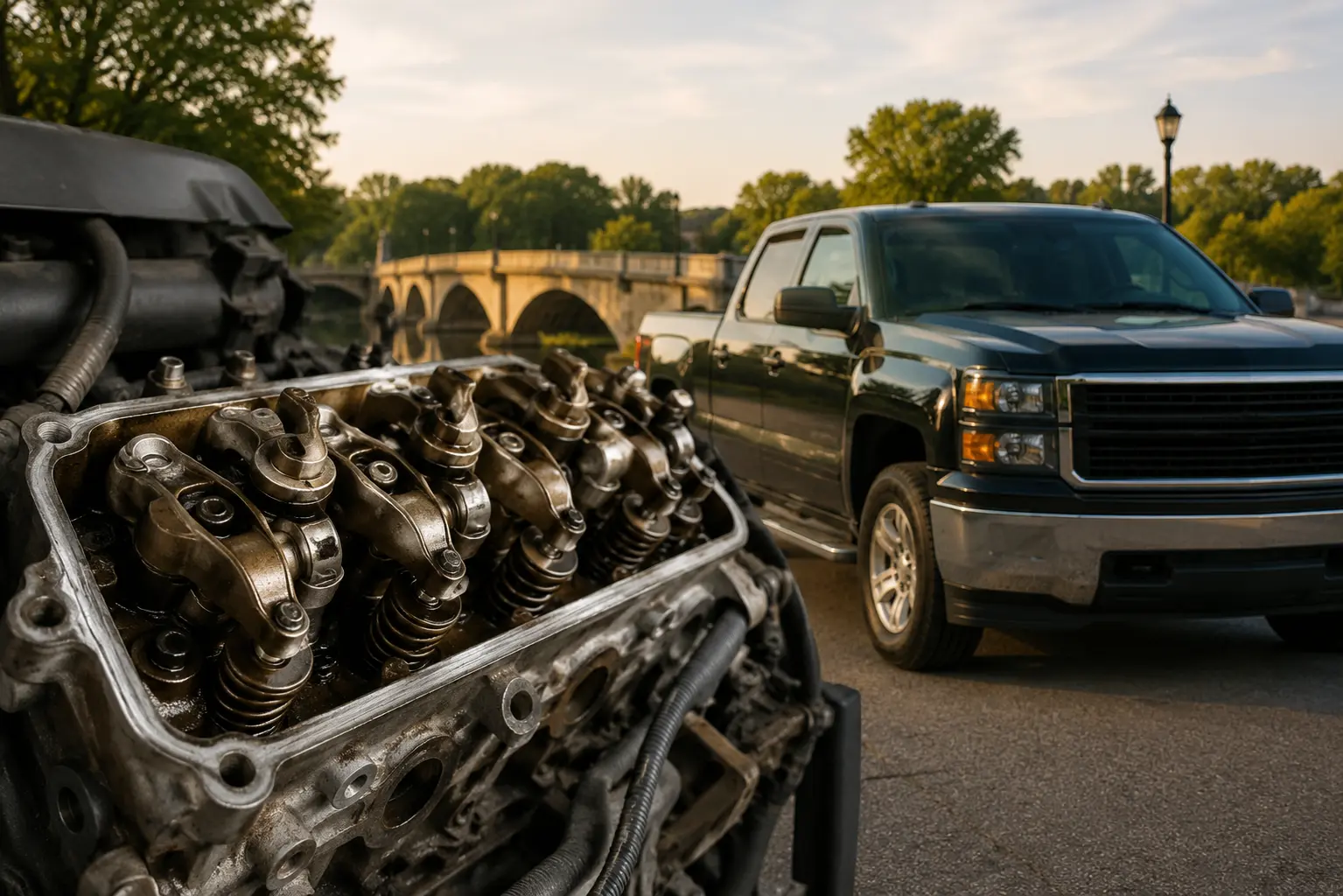
A new ticking noise from a Chevrolet Silverado, GMC Sierra, Tahoe, Yukon, Suburban, or Cadillac Escalade is easy to dismiss at first. Maybe it is normal injector noise. Maybe there is a small exhaust leak. Maybe the sound will disappear once the engine warms up.
But when that tick comes with a rough idle, a check-engine light, a cylinder misfire, hesitation, shuddering, or noticeable loss of power, it deserves a proper diagnosis.
Express Auto Service in Fredericksburg works on domestic and import vehicles with an emphasis on accurate diagnostics, general repair, and major repair. The shop’s technicians are ASE Certified, with many achieving ASE Master Technician status, and the business uses advanced diagnostic equipment to identify mechanical and electrical problems before recommending a repair.
That diagnostic approach matters with GM’s 5.3L and 6.2L V8 engines. Lifter problems are documented on certain GM applications, but a ticking, misfiring engine can also have an ignition, fuel, exhaust, compression, valvetrain, or other mechanical problem.
The important question is not simply, “Does this sound like a bad lifter?”
It is:
What is causing the engine to misfire, and what evidence proves it?
GM 5.3L and 6.2L Lifter Failure Symptoms: What Does a Bad Lifter Sound and Feel Like?
The first clue is often a noise, but an experienced technician looks at the entire symptom pattern rather than diagnosing from the noise alone.
The Express Auto Service issue database identifies loss of power, hesitation, misfire, stalling, shuddering, and tick or knock among the documented symptoms associated with the GM AFM/DFM lifter issue.
Ticking or Knocking From the Engine
A new mechanical tick deserves attention when it is persistent, becomes louder, or appears with a drivability problem.
One useful detail is when the noise occurs. A tick that is loudest during a cold start and changes as the engine reaches operating temperature can lead the diagnosis in a different direction than a noise that stays nearly identical hot or cold.
That does not identify the failed component by itself. It gives the technician another clue.
Rough Idle, Hesitation, and Shuddering
A misfiring cylinder changes the way the engine feels. At idle, the truck may shake or feel uneven. Under acceleration, it may hesitate, stumble, or feel weaker than normal.
Those symptoms can occur with a valvetrain problem, but ignition and fuel faults can create the same basic complaint.
P0300 and P0301–P0308 Misfire Codes
P0300 indicates random or multiple-cylinder misfire detection. P0301 through P0308 identify a specific cylinder.
A P0301 does not mean “replace the number-one lifter.”
It means cylinder one is misfiring.
That distinction is the foundation of good engine diagnosis. The code tells the technician where to look. Testing determines why the cylinder is misfiring.
A Ticking Silverado Can Look Like a Lifter Problem Before Testing Tells the Full Story
Consider a representative diagnostic situation: a Silverado arrives with a noticeable tick and a cylinder-specific misfire code. The owner has searched the code online and found stories about GM lifter failures.
The temptation is obvious: call it a lifter and start pricing the repair.
A technician should not stop there.
The misfire needs to be confirmed. Then the likely causes need to be separated. Is the cylinder losing spark? Is fuel delivery normal? Does it have normal compression? Is valve movement correct? Does the noise actually come from the valvetrain?
If ignition and fuel testing do not explain the problem and mechanical testing points toward abnormal valve operation, the diagnosis becomes much stronger.
That distinction matters because a weak ignition coil and a damaged lifter can create very similar symptoms for the driver, but they are completely different repairs. The smart money is spent proving the failure before expensive parts are ordered.
Is It Really a Lifter? Common GM V8 Problems That Cause Similar Symptoms
A GM V8 can misfire for many reasons. The job is to narrow those possibilities without replacing parts that were never proven faulty.
Spark Plug and Ignition-Coil Problems Can Mimic a Mechanical Failure
A worn spark plug, damaged plug, weak ignition coil, or related ignition fault can cause a cylinder-specific misfire.
If testing shows the misfire follows an ignition component, the diagnosis can stay in the ignition system. If the same cylinder continues to misfire after ignition problems are ruled out, the technician has a stronger reason to investigate fuel or mechanical causes.
Fuel and Injector Problems Can Produce the Same Complaint
Fuel delivery problems can produce rough running, hesitation, and cylinder-specific misfires as well.
Depending on the engine and symptoms, the technician may evaluate fuel pressure, fuel trims, injector operation, and related electrical signals.
The point is not to eliminate every conceivable fault. It is to eliminate the likely ones in a logical order.
Compression Problems Can Change the Entire Diagnosis
If a cylinder cannot maintain normal compression, the investigation moves toward a mechanical problem.
Compression testing, cylinder leakage testing, and valve-motion checks may be appropriate when earlier testing points in that direction. The knowledge base specifically directs the article toward explaining mechanical diagnosis rather than assuming the root cause from a symptom or trouble code.
An Exhaust Leak Can Sound Like a Lifter Tick
An exhaust leak near a manifold or another exhaust component can create a sharp ticking noise that sounds surprisingly mechanical.
If the noise is strongest when the engine is cold and changes as the metal heats up, an exhaust leak becomes more interesting diagnostically. It still has to be confirmed.
What Many Owners Don’t Realize
The most useful information is often not the exact description of the noise.
“There’s a tick” helps.
“There is a tick that started two weeks ago, the check-engine light appeared yesterday, and now the truck shakes at idle” helps much more.
That kind of history gives a technician something specific to reproduce and test.
AFM vs. DFM: Which GM 5.3L or 6.2L Engine Do You Have?
AFM and DFM are related but different cylinder-deactivation strategies, and the distinction matters when applying GM service information.
AFM, or Active Fuel Management, uses cylinder deactivation under certain operating conditions.
DFM, or Dynamic Fuel Management, is a later strategy that can vary which cylinders are deactivated depending on engine operating conditions.
That means a 5.3L Silverado from one generation should not automatically be treated as mechanically identical to a later 5.3L or 6.2L vehicle.
The same caution applies to the model name. A Silverado badge tells you the truck. It does not tell you every detail of the engine inside it.
Why Model Year and Engine Configuration Matter
Before applying a known-issue diagnosis, verify:
- Model year
- Exact vehicle
- Exact engine
- Engine configuration or RPO where applicable
- VIN
- Applicable GM service information
The Express Auto Service issue base identifies the broader verified concern across Silverado, Sierra, Tahoe, Suburban, Yukon, and Escalade applications, but that does not mean every engine uses identical hardware or has the same repair procedure.
GM 5.3L and 6.2L Applications Need to Be Treated by Generation
For a technician, “5.3” or “6.2” is only the starting point.
The exact generation and configuration determine which cylinder-deactivation system, valvetrain components, diagnostic procedures, and service information apply.
That is why a model-specific internet story can be useful background information but should never replace identification of the actual vehicle in the bay.
What Causes GM AFM and DFM Lifter Problems?
The lifter is part of the valvetrain. Its job is to work with the camshaft and related components so the valves open and close correctly.
Cylinder-deactivation systems add another layer because the valvetrain has to support normal engine operation and the engine’s strategy for deactivating cylinders.
On applicable GM engines, lifter problems can lead to abnormal valve operation, a tick, and misfire symptoms. The Express Auto Service knowledge base identifies the GM 5.3L, 6.0L, and 6.2L AFM/DFM lifter-collapse issue as verified across a broad family of GM trucks and SUVs.
Once a mechanical lifter problem is confirmed, the diagnosis does not automatically end there.
The camshaft and related valvetrain components may need inspection. The condition of those components determines whether the repair stays relatively focused or becomes a larger internal-engine job.
Why a Lifter Problem Can Become a Larger Repair
Two assumptions are equally unhelpful:
“It’s just a lifter.”
and
“The engine is definitely ruined.”
Neither can be justified without inspection.
Repair scope depends on what the technician actually finds.
How Does a Professional Shop Diagnose a GM 5.3L or 6.2L Lifter Problem?
A good diagnosis starts by proving what the engine is doing.
Start With the Complaint and Vehicle History
The technician needs to know:
- When the noise started
- Whether it is worse cold or hot
- Whether the misfire is constant or intermittent
- Whether the truck shakes at idle
- Whether power has dropped
- Whether the check-engine light flashes or stays on
- Whether recent repair or maintenance work was performed
Those details help determine which tests make sense next.
Scan the Vehicle and Review the Data
Stored and pending trouble codes matter, but live data and misfire information can be even more useful.
A P0301 tells the technician cylinder one is misfiring. It does not say whether the cause is a coil, plug, injector, compression problem, valve problem, or lifter.
That is where advanced vehicle diagnostics become more valuable than simply reading a code and searching for the most common repair.
Rule Out Ignition and Fuel Causes Before Condemning the Engine
If ignition testing identifies a weak component, the repair may end there.
If fuel testing points toward an injector or fuel-delivery problem, the diagnosis changes.
If those systems check out, mechanical testing becomes more important.
That conditional reasoning keeps a technician from replacing good parts.
Move Into Mechanical Testing When the Evidence Calls for It
Depending on the findings, the diagnostic process may include:
- Compression testing
- Cylinder leakage testing
- Valve-operation checks
- Valvetrain inspection
- Camshaft inspection
- Additional engine-control testing
The point is not to perform every possible test on every vehicle. The point is to choose the test that answers the next diagnostic question.
Determine the Repair Scope
Once the failing component is established, the technician still needs to determine whether there is related damage.
That may require evaluating:
- Lifter condition
- Camshaft condition
- Pushrods
- Lifter-control oil components
- Other valvetrain parts
The diagnosis is not complete until the technician understands what needs to be repaired and why.
When Should You Stop Driving a GM 5.3L or 6.2L With a Misfire or Tick?
Not every engine tick means the truck needs to be towed immediately. Some symptoms, however, change the level of urgency.
A Flashing Check-Engine Light Deserves Immediate Attention
A flashing malfunction indicator generally indicates an active misfire.
That is different from a steady light with no noticeable drivability problem.
Severe Shaking, Major Power Loss, or Stalling Is More Concerning
If the truck is shaking hard, losing significant power, stalling, or developing a pronounced mechanical knock, continued normal driving is not something to take lightly.
The same goes for an oil-pressure warning or overheating condition.
A Practical Technician’s Rule
From a technician’s standpoint, a new mechanical tick combined with a misfire is enough to move the vehicle up the priority list.
That does not mean the engine is finished.
It means the cause should be established before the truck is used normally for days or weeks.
A lot of owners want to know how many miles they can “get away with.” There usually isn’t a responsible universal number. The better answer comes from finding out what is actually failing.
What Does GM 5.3L or 6.2L Lifter Repair Actually Involve?
Once a lifter problem is confirmed, the repair depends on the condition of the affected components.
Lifter Replacement May Be Part of the Repair
GM service procedures for applicable vehicles may call for replacement of affected lifters and related components when the condition is confirmed.
That does not mean every GM V8 receives the same repair.
The Camshaft Needs to Be Inspected
A technician needs to determine whether the camshaft remains serviceable.
If a lifter has caused or is associated with camshaft damage, replacing only the lifter would not address the complete problem.
Related Damage Determines the Final Repair
Depending on the findings, the repair can involve:
- Lifter replacement
- Camshaft replacement
- Pushrod inspection or replacement
- Lifter-control oil components
- Other valvetrain work
The most expensive part of a lifter problem may not be the lifter itself. It can be the related damage that has to be addressed at the same time.
Does a Lifter Problem Automatically Mean Engine Replacement?
No.
The correct repair depends on the evidence.
Sometimes the repair remains focused on the valvetrain. Sometimes the inspection shows a larger internal-engine problem. The technician should be able to explain what failed, what was inspected, and why the proposed repair addresses the actual condition.
How Does a Technician Verify a GM Lifter Repair Worked?
Repair is only half the job.
The other half is confirming that the original complaint has actually been corrected.
Depending on the vehicle and repair procedure, verification can include:
- Rechecking diagnostic trouble codes
- Reviewing misfire data
- Confirming proper valvetrain operation
- Checking engine performance
- Road-testing the vehicle under relevant conditions
- Confirming that the abnormal noise and drivability problem are gone
The exact verification procedure should follow the vehicle’s service information and the repair performed.
From a technician’s standpoint, “the parts were installed” is not the finish line.
The vehicle needs to prove the repair worked.
What Can a GM Owner Safely Check Before Bringing the Vehicle to a Shop?
You do not need to remove a valve cover or start taking the engine apart to provide useful diagnostic information.
Check the Engine Oil Level
Verify the oil level using the vehicle manufacturer’s procedure.
Low oil is important information for the technician. It does not prove that a lifter has failed, and topping off the oil does not repair a mechanical lifter problem.
Pay Attention to When the Noise Occurs
Note whether the sound is:
- Cold-start only
- Most noticeable at idle
- Worse during acceleration
- Present after the engine warms up
- Constant
That information can help reproduce the complaint.
Pay Attention to What the Engine Is Doing at the Same Time
Is the truck:
- Shaking?
- Hesitating?
- Losing power?
- Stalling?
- Running smoothly except for the noise?
The combination is more useful than the noise by itself.
Preserve Diagnostic Information
If a code has already been retrieved, write it down.
Avoid clearing the code just because the light turned off. Intermittent problems can become harder to diagnose when useful stored information disappears before the vehicle is evaluated.
What Should You Tell the Technician Before the GM V8 Is Diagnosed?
A good repair visit can start with a better complaint description.
Tell the technician:
- When the noise started
- Whether it began suddenly or gradually
- Whether it is louder cold or hot
- Whether the engine shakes
- Whether the check-engine light flashes or stays on
- Which code was found, if any
- Whether the truck has lost power
- Whether the problem started after an oil change, ignition repair, or other service
You do not need to diagnose the vehicle yourself.
A better description is:
“It started ticking last Tuesday, the noise is loudest at idle, the check-engine light started flashing yesterday, and now it shakes when I stop.”
That gives the technician something concrete to reproduce.
GM 6.2L L87 Recall vs. AFM/DFM Lifter Problems: What Is the Difference?
These subjects are easy to confuse online, but they should be kept separate.
The broader AFM/DFM lifter concern is one category of GM V8 problem.
The L87 recall is a separate issue involving certain 6.2L-equipped vehicles.
The knowledge base identifies NHTSA recall 25V-274 for certain 2021–2024 6.2L L87-equipped Silverado, Sierra, Tahoe, Suburban, Yukon, Yukon XL, Escalade, and Escalade ESV vehicles and specifically instructs writers to keep the recall population distinct from broader GM engine and lifter claims.
The recall concerns certain connecting-rod and crankshaft engine components that can cause engine damage and engine failure.
That is not the same thing as saying every 6.2L ticking noise is an AFM/DFM lifter failure.
Check the VIN Before Assuming a Recall Applies
A vehicle should not be called “recalled” based solely on its model and year.
Use the NHTSA VIN recall lookup to determine whether the specific vehicle has an open safety recall.
A recall is also different from:
- A technical service bulletin
- A documented common failure
- An out-of-warranty repair
If a vehicle has an applicable safety recall, the owner should follow the manufacturer’s recall remedy instructions.
Expert Tip: Diagnose the Cylinder, Not Just the Code
A trouble code tells you what the vehicle detected; professional diagnosis determines what actually failed.
If a 5.3L Silverado shows P0301, the better question is not:
“Which lifter should I replace?”
It is:
“Why is cylinder one misfiring?”
If ignition testing identifies the cause, the repair may stay in the ignition system.
If fuel testing points toward an injector or fuel-delivery issue, the repair changes.
If the cylinder continues to misfire and mechanical testing shows abnormal valve or compression behavior, the investigation moves into the engine.
That is what a diagnosis is supposed to accomplish.
What an Experienced Technician Looks For When a GM V8 Comes In With a Tick
When a GM V8 comes into a shop with a tick, the first question should not be “Which famous GM problem is this?”
It should be:
What can I prove?
An experienced technician wants to reproduce the noise, confirm the misfire, identify which cylinder is affected, and determine whether the ignition and fuel systems are behaving normally.
If those systems check out, the investigation becomes increasingly mechanical.
That progression matters because two vehicles can have almost identical customer complaints and still need very different repairs.
A 5.3L truck with a ticking noise and no misfire is a different diagnostic problem from a 5.3L truck with the same tick plus a persistent P0301 and abnormal cylinder compression.
The symptoms may sound similar to the owner.
They do not necessarily mean the same thing to the technician.
GM 5.3L and 6.2L Lifter Failure FAQs: What Owners Ask Before Repair
Can a bad GM lifter cause a misfire?
Yes. GM’s documented AFM lifter concerns include misfire and tick conditions on applicable vehicles.
But a misfire has many possible causes, so the lifter still has to be confirmed.
What does a collapsed AFM lifter sound like?
It can produce an abnormal valvetrain tick on applicable engines, particularly when accompanied by a misfire. Sound alone cannot reliably distinguish a lifter from an exhaust leak, injector noise, or another valvetrain problem.
Can you drive a Silverado with a bad lifter?
That depends on the confirmed condition and symptoms. A flashing check-engine light, severe shaking, major power loss, loud mechanical noise, overheating, oil-pressure warning, or stalling all warrant prompt attention rather than normal continued driving.
How do you diagnose a bad lifter on a GM 5.3?
A proper diagnosis starts with the codes and engine data, confirms the misfire, evaluates ignition and fuel systems, and moves into mechanical testing when the evidence requires it.
Does a GM 6.2L have AFM or DFM?
It depends on the exact application and model year. The specific engine configuration should be verified rather than assuming every GM 6.2L uses the same cylinder-deactivation system.
Is the GM 6.2L lifter problem covered by a recall?
Not every GM 6.2L lifter concern is covered by the same recall. Certain 2021–2024 L87-equipped GM vehicles are included in NHTSA recall 25V-274 for a separate engine-component issue. Recall eligibility should be verified by VIN.
Does every P0300 or P030x code mean the lifter is bad?
No. The code identifies a detected misfire condition. It does not identify the failed component.
Does every lifter failure require an engine replacement?
No. The repair depends on what inspection finds. Some repairs may remain focused on lifters and related valvetrain components, while camshaft or other internal damage can make the repair more extensive.
GM V8 Engine Diagnostics and Repair in Fredericksburg, VA
A ticking or misfiring GM V8 does not need a guess. It needs a diagnosis.
Express Auto Service, located at 2201 Emancipation Hwy, Fredericksburg, VA 22401, provides engine diagnostics and repair along with general and major repair for domestic and import vehicles.
For a Fredericksburg-area driver, the practical question after a new GM V8 tick is usually not how many more miles the truck can go. It is whether the cause can be identified before a manageable repair becomes a larger one. Drivers looking for auto repair in Fredericksburg, VA can have the vehicle properly evaluated instead of guessing at the cause.
If your Silverado, Sierra, Tahoe, Suburban, Yukon, or Escalade is ticking, misfiring, losing power, or showing a warning light, call Express Auto Service at (540) 372-4422 to schedule a diagnostic evaluation.
